Detect
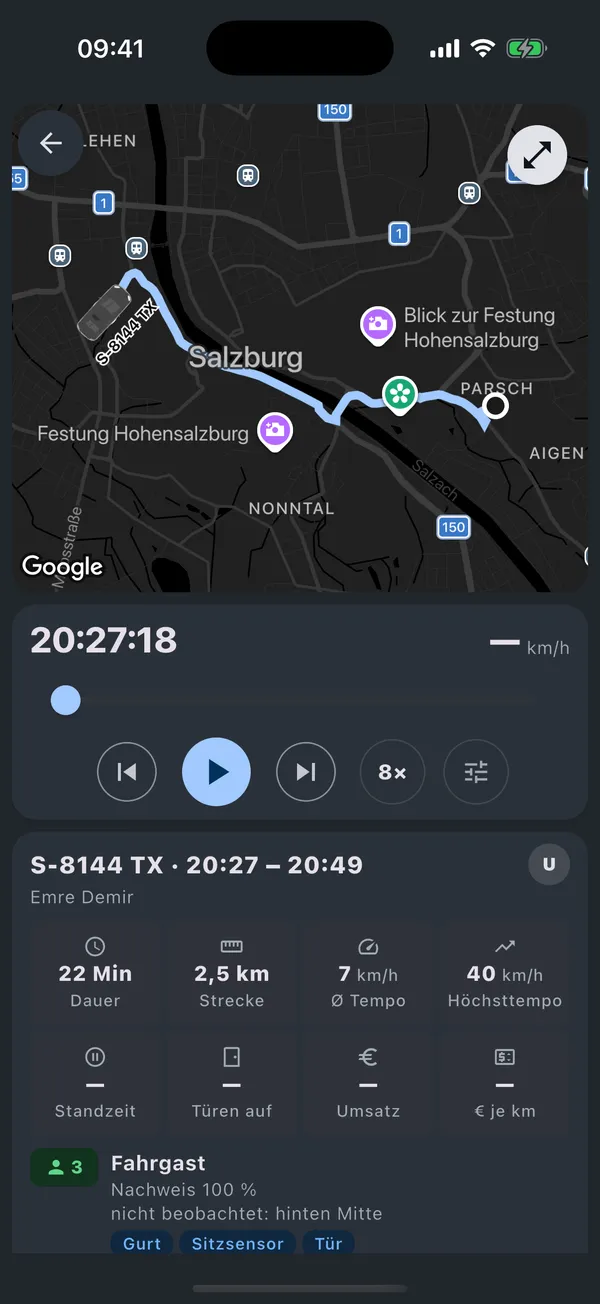
The car itself tells whether somebody is sitting in the back.
No single signal decides. The rear door, the rear end that sinks, the belt, the driving after the stop: together they form a picture that was measured against the seat mat. And the method keeps learning: when it improves, past days are recalculated.
- occupied trips found without a seat sensor
- 86 / 87
- of stops correctly judged as rear seat occupied
- 98.6 %
- of rear boardings detected via the door
- 97.7 %
- a fastened passenger belt means a passenger
- 99.4 %
The problem
- Nobody wants a camera in a taxi, neither driver nor passenger. A seat sensor costs installation time per car.
- Without proof that somebody was inside, every fare evasion question is an argument about words.
- Belt counters alone are not enough: in the back only every second passenger buckles up.
A case from daily operations
The night trip without a taximeter
Rear door open, rear end sinks, eleven kilometres driven, meter off, no platform trip to go with it. How a trip ends up on the review list in the morning.
How it works
- 01
The rear door opens
Without an opened rear door nothing changes in the back, in 349 checked stops without a single exception. Only the boot does not count as boarding.
- 02
The rear sinks, the car drives
Every person in the back pushes the rear measurably lower. Whoever barely drives after the stop is waiting empty at the rank. A belt that clicks in confirms it.
- 03
The whole shift is assessed
Boarding and alighting alternate. The evaluation looks at all stops of a shift together and only then decides, not on a single signal.
What it does not do
- A person and luggage on the rear bench cannot be told apart by the suspension.
- Without a rear door signal or with a device installed askew the method fails; then the seat sensor helps.
- The method was measured on one vehicle over five nights against the seat mat; on two further vehicles 13 of 13 and 26 of 29 belted trips.
Questions
So I do not need a seat sensor at all?
For most cars, no. Where the model provides no door and belt signals, or where you want proof per trip instead of a probability, the seat sensor is added.
What about the front passenger seat?
Many models report “front passenger present” and the front passenger belt. Both are taken into account, the driver's belt never counts.
Can a driver trick it, for example with a belt that stays buckled?
A belt buckled for more than eight hours straight is discarded and reported as an anomaly.
How reliable is the result?
At the stop 95.8 percent correct, “rear occupied” 98.6 percent, 86 of 87 occupied trips found, one too many. The numbers with their sources are on the Numbers page.
Let us show you on your own cars.
Half an hour, no obligation. You see the app with real data and get a quote for your fleet.